Nimbarkacharya
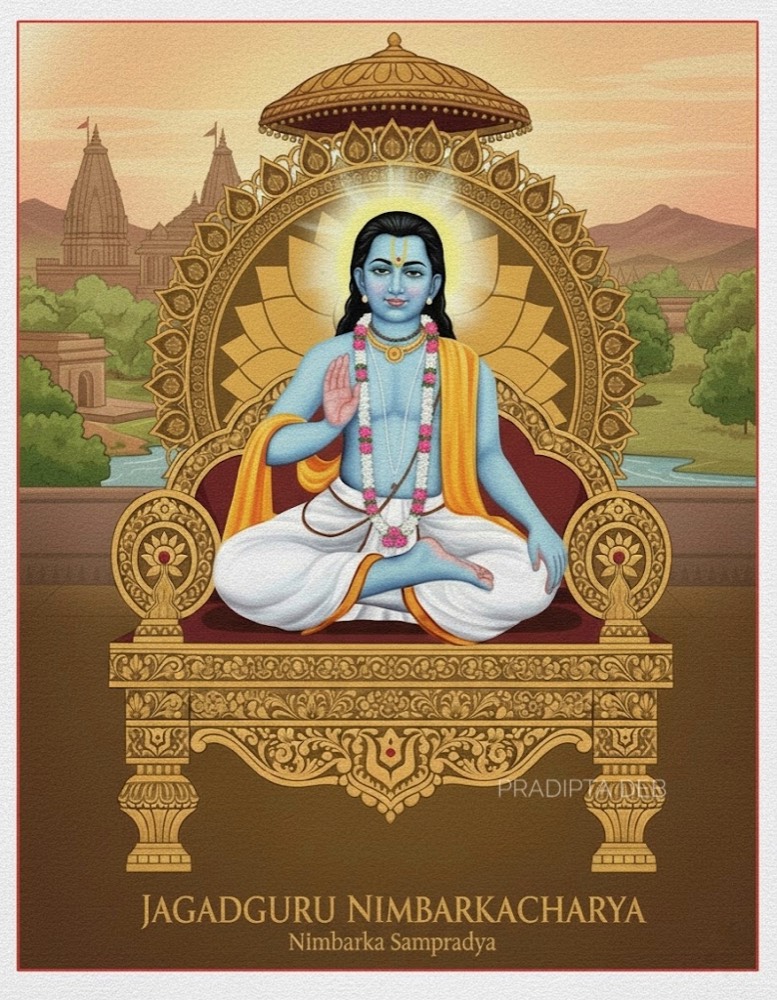
If you’ve ever felt close to Śrī Krishna and Rādhā Rāṇī as your God, you should know about one of the earliest Vedānta scholars to see & worship them as the Supreme Brahman, too.
That’s Nimbārkācārya, the founder of the Dvaitādvaita school of vedic philosophy - and here’s his story.
He was born as Niyamānanda or Aruṇa in Andhra or Maharashtra, and his family migrated to Vraja Bhumi, near Govardhan Hill, a region famous for being part of Krishna’s life story, including Mathura, Vrindavan, Neemgaon, etc. which all became his spiritual centres for teaching.
His name “Nimbārka” comes from later legends linking him with neem trees and solar miracles.
His core teaching is referred to as Dvaitādvaita or “dualistic non-dualism’, with which he founded the Kumāra or Sanaka Sampradāya, one of the four major Vaiṣṇava lineages, along with the Śrī Vaishnava (by Rāmānuja), Brahma Vaishnava (by Madhva), and Rudra Vaishnava/Pushtimarg traditions (by Vallabha).
For him, Śrī Krishna is the Supreme Brahman, and Rādhā is His eternal creative energy - inseparable and co-absolute in creating the universe. This union is symbolized by the Nimbārkī tilak: two vertical lines joined by a red dot.
Unlike Advaita, which says everything is one, and Dvaita, which says everything is different - Nimbārka held both to be true.
For him, the soul (jīva) and world (jagat) are always different from God - but they’re also never separate from Him. Like sparks or embers from a campfire or rays & beams coming out from the sun - they come from Him, depend on Him, and shine because of Him.
This is slightly different from Rāmānuja’s Viśiṣṭādvaita, special non-dualism, which says God is like the soul, and everything else - souls and world - are like His body. They’re part of Him, with no separate existence.
But Nimbārka says the soul and world are truly different from God, yet always connected to Him - held together by His power and grace.
His recommended path to moksha, too, becomes Bhakti - emphasising sakhī-bhāva seva - worshipping & serving the Divine Couple like the gopīs of Vraja did: with playful, loving devotion.
Nimbārka urged devotees to live morally - practicing compassion, vegetarianism, ahiṃsā (non-violence), nāma-saṅkīrtana (chanting), parikramā of Vṛndāvana’s sacred sites, and initiating oneself into the sect through the Gopāla Mantra, an 18-syllable chant central to his lineage.
His followers root their faith in the Nimbarkas’ Brahma Sutra Bhashya, and also his commentaries on Upanishads & Gita, later setting the devotional mood with the Brahma Vaivarta Purāṇa, and the Garga Saṁhitā, and Śrīmad Bhāgavatam.
His work affirms the diversity in Vedānta rather than attacking other schools. His Dvaitādvaita builds a bridge between the opposites of Dvaita & Advaita.
So if you love Krishna & Rādhā, Nimbārka might just be your philosophical home!
Share & follow to know more!