Aryabhata
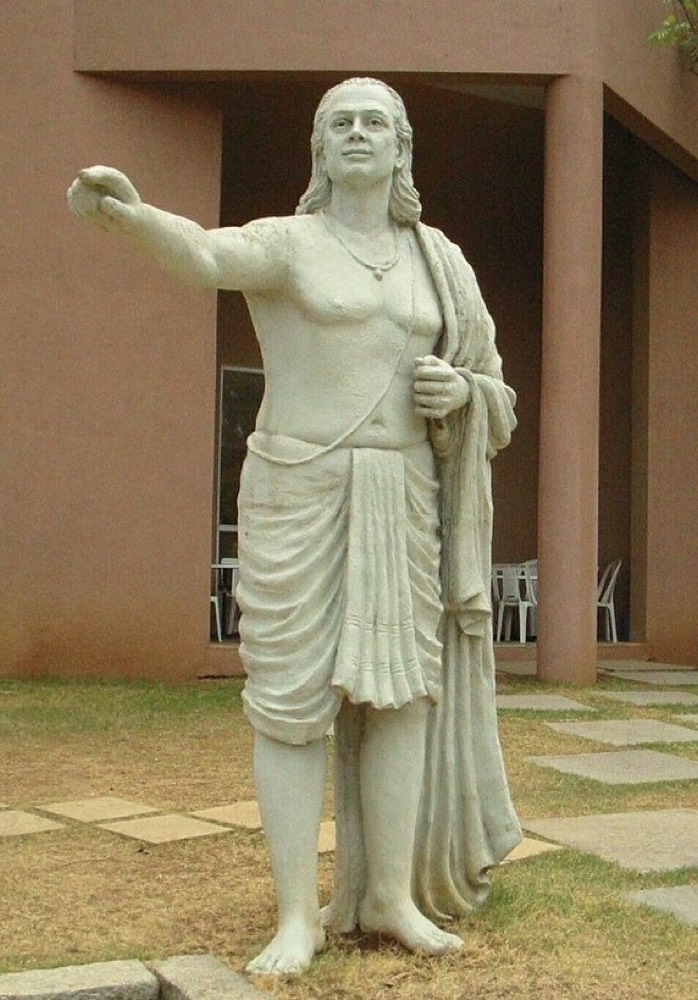
Did you hate math in school, too?
Maybe you just never had a teacher like Aryabhata - the man who showed us the music behind numbers & mapped the cosmos without ever leaving Earth.
Here’s his story.
BTW, I’m introducing you to one real Hindu thinker every day - so if you want to meet the heroes who built Sanatan Civilization, follow this page now.
Aryabhata was born around 476 CE, likely in Kusumapura - modern-day Patna - during the golden age of the Guptas.
By 23, he wrote the legendary Aryabhatiya, a Sanskrit masterpiece in four parts:
+ Gītikāpāda: Cosmology and massive time cycles
+ Gaṇitapāda: Arithmetic, algebra, trigonometry
+ Kālakriyāpāda: Planetary motions and timekeeping
+ Golapāda: Spherical astronomy and eclipses
This wasn’t myth - it was math.
With regards to astronomy , centuries before Galileo & Copernicus realised it & told the world, Aryabhata had already figured out that the Earth is the thing that rotates, not the sky.
He also calculated Earth’s circumference with striking accuracy, worked out planetary distances, sidereal time, and explained the science behind eclipses using geometry, debunking the myth of it being caused by the demon Rāhu.
In mathematics, he broke away from Roman chaos and invented a system to encode huge numbers using letters, making complex calculations easier.
More importantly - he championed the use of a system called place-value logic, which basically shaped how you see numbers today.
For example, 213 means = 2 in the hundreds place, 1 in the tens, 3 in the units. This seems obvious now, but was a radical idea back then that he popularised.
He also championed trigonometry, which helps us measure how far things are without having to build long physical rulers.
He explained values like jya (sine), kojya (cosine), and utkrama-jya (versine) - and created the first sine tables in the world, numbers that help us know our distance to mountains, stars & space.
Not to forget, he gave us one of the first near-precise values of the magic number found in circles measurement called Pi ≈ 3.1416.
His work inspired a whole generation of thinkers like Varāhamihira, Bhāskara, and Brahmagupta … and today our technologies, machines, economies & missions into space run on his knowledge!