Peshwa Bajirao
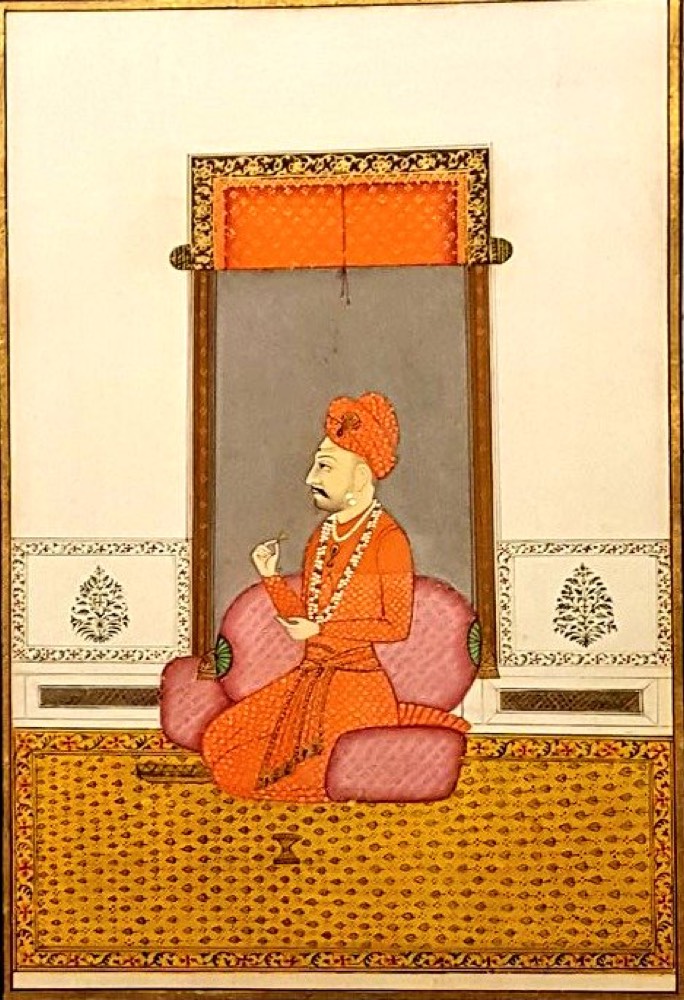
What happens when your entire team is scattered without a strong pillar? Dharma sends a bold leader to unite them all & win the battle. This is the story & legacy Peshwa Bajirao, one of the fiercest Maratha warriors we’ve ever seen.
After Chhatrapati Shivaji Maharaj’s death in 1680 & a valiant effort to continue the Maratha struggle against the Mughal Empire for another 20 years by Chhatrapati Sambhaji Maharaj, we had effectively exhausted their military machine.
But at the same time, our own people were fragmented, suffering from many internal conflicts. Sambhaji’s son, Chhatrapati Shahu Maharaj I, was released to further escalate the civil war between him and Tarabai, his aunt & Shivaji’s daughter-in-law.
But Balaji Vishwanath, appointed as the first Peshwa or Administrative & Military Head by Shahu, played a crucial role in stabilising matters. All this while, his son, Visaji, was watching the chaos firsthand, and dreamed of uniting the broken Marathas to fulfil Shivraya’s mission.
In 1720, after his father passed away, he got his chance when was elevated to the Peshwa pad, immortalising his title as the commander Bajirao.
Bajirao is important in our Hindu history because while Shivraya gave us the idea of Swarajya, Hindu rule, he gave us a more aggressive & necessary ambition of Hindu-Pad-Padshahi, a collection of Hindu empires across the subcontinent, without which our cultural and religious centres like Kashi would always be under threat.
By articulating such a grand vision of a pan-Indian Hindu empire, Bajirao united the Marathas once again, also elevating many from all sorts of backgrounds into leadership positions, which formed a loyal army of strong soldiers around him.
Bajirao had seen that the Mughals were drunk & exhausted - he did not want to lose the opportunity to finish them once & for all. So in the decade spanning 1727 to 1737, he launched extremely daring attacks, first neutralising the Nizam in the South and mobilising light cavalries directly on to Delhi.
Bajirao’s speciality was his ability to be extremely light & fast with his cavalry, almost invisible, like a cheetah & a hawk.
But apart from waging wars, he also established diplomatic ties with rulers in the North-Western Rajputana region.
Transforming Pune into his strategic administrative capital, building the iconic Shaniwar Wada, he left his brother Chimaji Appa and his extremely capable wife Kashibai to manage matters at home.
Unfortunately, Bajirao’s second marriage with Raja Chhatrasal’s daughter, Rani Mastani, who had mixed Islamic heritage, caused his own family members and the Brahmin community to revolt against him, bringing huge distress & violent abuse to both of them until the very end. So its ironic that he shook almost all of the country but had to suffer right at home from social taboos & norms of his time.
Unfortunately, pop cultures & movies have dialled up the melodrama of the story by turning complex characters into one-dimensional bad or good figures, but that’s not how it was in real life.
Ultimately, decades of war had exhausted Bajirao’s body, and in 1740, at Raverkhedi in present-day Madhya Pradesh, while en route to Delhi, he succumed to wounds & camp sickness. Do visit his samadhi if you ever pass the region on the banks of the Narmada river.
His contribution re-ignited the Maratha flame, permanently quashing any hopes of Mughal dominion over Bharat. That’s the kind of leader we need.